Hajar ul Aswad in Istanbul
A Hidden Connection to Makkah in the Heart of Istanbul Sokullu Mahmad Pasha Masjid
Most people think a spiritual connection to Makkah requires a long journey. And often, it does. Standing before the Kaaba is something millions dream of for years. Even catching a glimpse of Hajar al Aswad in Istanbul—known in English as the Sacred Black Stone—is a moment many never forget.
But what if part of that story has quietly been waiting much closer than you think?
In Istanbul, tucked away from the usual tourist routes, there is a masjid (mosque) that carries a unique and deeply meaningful connection to this sacred history. It is a unique spot that you should never miss during your Istanbul tour and Turkey tour
A Mosque Unlike Any Other with Hajar ul Aswad in Istanbul
The Sokullu Mehmet Pasha Mosque—often simply called Sokullu Mosque—is widely considered one of the finest works of Mimar Sinan. Built in 1571 during his master period, it reflects not only architectural brilliance but also a rare spiritual distinction.
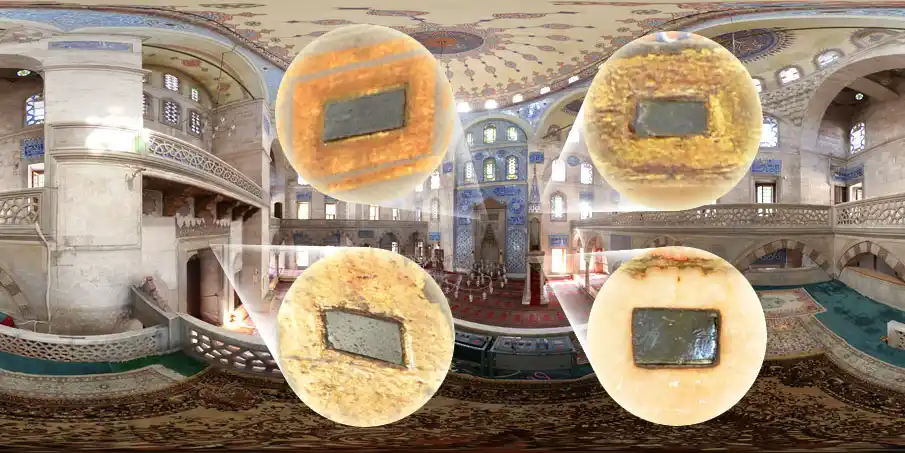
It is believed to be the only mosque in the world that incorporates fragments associated with Hajar al-Aswad directly into its structure.
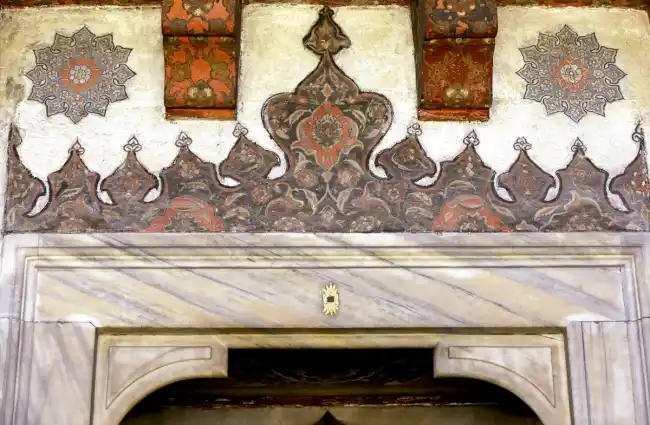
These pieces, each roughly around 10 centimeters in size, were reportedly brought during the construction of the mosque. Today, they are carefully embedded in four different locations: above the main entrance, at the center of the mihrab, above the pulpit entrance, and within the dome of the minbar. Each fragment is set within delicate gold frames, quietly preserved yet still visible to those who know where to look.
A Quiet Corner of the City
Located in the Kadırga neighborhood, on a sloping street just a short walk from the Sultan Ahmed Mosque, the mosque sits slightly out of the spotlight. You won’t find overwhelming crowds here. In fact, it’s easy to miss entirely if you’re not looking for it.
And that’s part of its charm.
Despite holding something of immense value for the Muslim world, it remains a calm, almost hidden space—waiting for visitors to discover it at their own pace.
Built with Devotion and Elegance
The mosque was commissioned by Sokollu Mehmed Pasha in honor of his wife Ismihan Sultan, the daughter of Sultan Selim II. Like many Ottoman complexes, it was designed as more than just a place of worship.
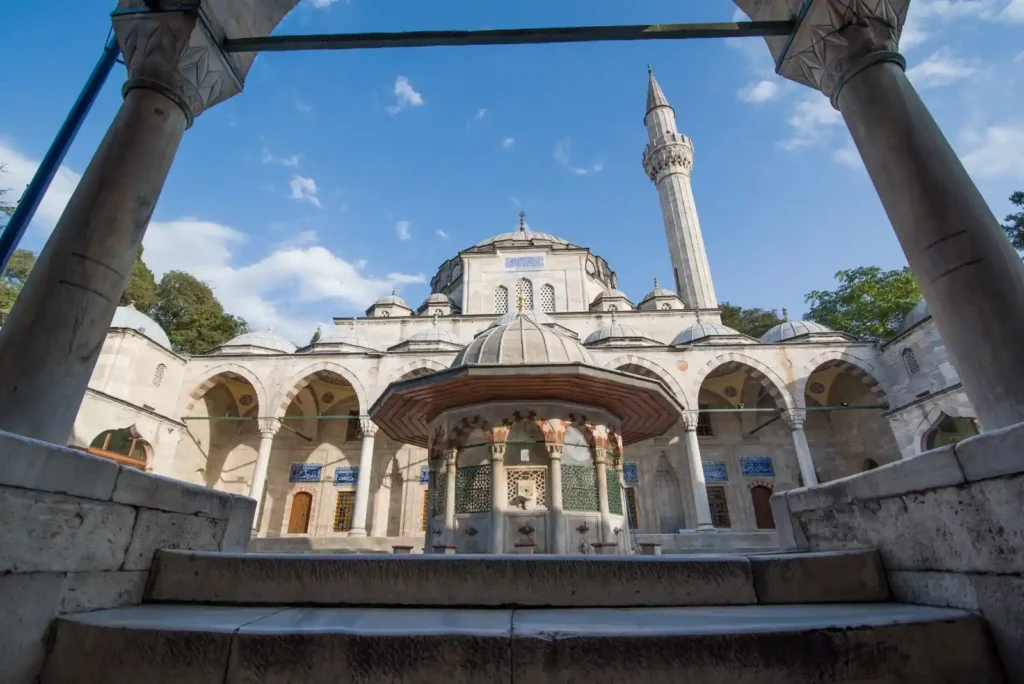
Unlike large imperial mosques, Sokullu Mosque does not have a grand outer courtyard. Instead, you enter through a modest staircase leading into an intimate inner courtyard. From the very first step, there’s a sense of warmth—something inviting and human in scale.
The courtyard is surrounded on three sides by arcades and sixteen small domed rooms, originally built as part of a madrasa. Today, these spaces continue to serve educational purposes, often used for Qur’an teaching.
Even small details—like the marble fountain at the center, the carved columns, or the domed porticos—carry the careful touch of a master architect.
Architecture That Speaks Softly
Though relatively small and built with a single minaret, the mosque reflects the confidence of Sinan’s mature style. The central dome rises elegantly, supported by a hexagonal system—an evolution of a plan he explored in earlier works but refined here with greater balance.
On either side of the main space are smaller domed sections, traditionally used as areas reserved for women. The structure feels cohesive, neither overwhelming nor overly simple—just carefully measured.
What stands out most is how everything works together. Nothing feels excessive.
Decoration That Respects the Space
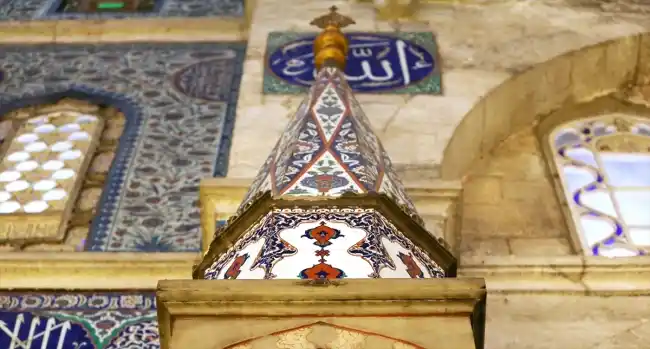
Inside, the mosque reveals another layer of beauty through its tilework. İznik tiles decorate key areas—the mihrab wall stretching upward, the arches of the dome, window panels, and even parts of the pulpit.
There is a richness here, but it never feels heavy. The decoration supports the architecture rather than competing with it. It’s a quiet balance—color and form working together instead of one overpowering the other.
A Hidden Detail Above You
One of the lesser-known aspects of the mosque is something you wouldn’t immediately notice unless it was pointed out.
Mimar Sinan paid close attention to acoustics in all his works. In this mosque, he used an unusual but effective solution: empty clay jars.
These jars were embedded into cavities around the base of the dome. Their purpose was to collect and balance sound within the space, ensuring that even a soft voice could carry clearly. It’s a subtle detail, but one that shows how deeply thought-out the design really is.
A Resilient Structure
Since the day it was built, the mosque has survived centuries without suffering major damage from earthquakes or fires—a remarkable achievement in a city like Istanbul. It has remained open for worship throughout its history, quietly continuing its purpose.
And yet, despite all this, it remains overlooked.
Perhaps because it sits just off the main paths, it doesn’t receive the attention it deserves. But those who do find their way there often leave with a very different kind of impression—something more personal than what larger, more crowded landmarks offer.
More Than a Visit
Standing inside this mosque, knowing that fragments linked to Makkah are part of its walls, creates a different kind of experience. It’s not about spectacle. It’s quieter than that.
It’s about connection.
In a city full of monumental sights, the Sokullu Mehmet Pasha Mosque offers something else entirely—a moment to slow down, to notice, and to reflect.
Sometimes, the most meaningful places aren’t the most obvious ones.
And sometimes, a journey doesn’t require crossing continents—just paying a little more attention to what’s already around you.